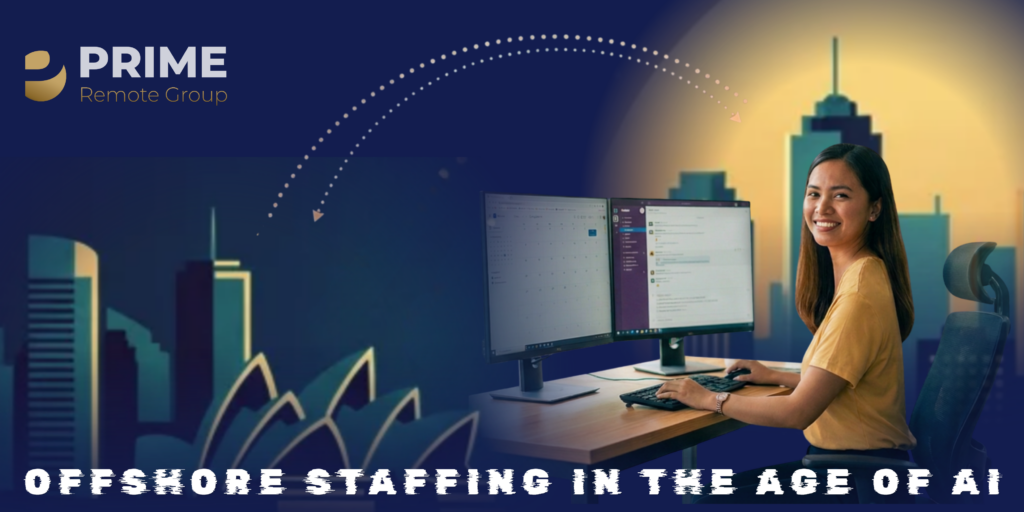
If you run a small or mid-sized business in Australia, you’ve probably heard two conflicting stories this year. One says AI is about to wipe out outsourced work in the Philippines. The other says offshore staffing has never been more useful. Both have some truth in them.
This guide explains what is changing in offshore staffing in the Philippines, why the change matters, and how to build a remote team that gets more valuable as AI tools improve.
What is happening to the Philippine outsourcing industry?
The Philippines is one of the world’s biggest outsourcing hubs, and Wikipedia’s overview of the sector puts its revenue at USD 38.7 billion in 2024. The past year has brought a correction, though. (Wikipedia)
In July 2026, the IBPAP (the local IT-BPM trade body) cut its 2028 revenue target from $59 billion to between $43.3 and $50.5 billion, blaming AI adoption and stronger global competition. Coverage of the downgrade also notes that an IMF white paper found roughly a third of Philippine jobs are at risk from AI, with outsourcing among the most exposed sectors. (virtualventurescorp) (metaintro)
The headline numbers sound alarming, but they describe the industry as a whole. They do not describe every kind of outsourced role equally.
Which roles are most exposed, and which are not?
The work most at risk is high-volume, scripted and repetitive: basic call handling, simple data processing, templated content. Software can already do a lot of this.
The work that holds up depends on context and judgment. A virtual assistant who has spent a year learning your clients, your tone, your systems and your priorities is doing something a generic tool can’t. One analysis of the forecast cut argues that dedicated offshore staffing, where a full-time professional works exclusively for one company, remains resilient because the role demands adaptability, client-specific knowledge, and judgment that AI cannot replicate independently. (That article comes from an offshore staffing provider, so read it with that in mind.) (virtualventurescorp)
The pattern across the industry is that AI is automating repetitive work while letting offshore professionals focus on higher-value activities that need creativity, analysis and strategic decision-making. (365outsource)
Dedicated virtual assistants vs. traditional BPO seats
Australian businesses can buy offshore capacity in three broad ways:
- Seat-based BPO: you rent capacity in a large call-centre operation. It suits high, predictable volumes, but the work is the most exposed to automation.
- Matchmaking or job boards: you hire a Filipino VA directly and manage them yourself. This is the cheapest route but it puts all the management on you.
- Dedicated, managed virtual assistants: a full-time VA works only for your business, and a provider handles recruitment, training and ongoing support. This is the model Prime Remote Group offers, with office-based VAs who work exclusively for one client.
For most owner-operators, the third option protects the things AI can’t replace: continuity, context and accountability.
Why the Philippines still works for Australian businesses
Geography helps. The Philippines sits just 0-3 hours behind Australian business hours, so your offshore team works your day rather than the reverse. Add strong English, cultural familiarity with Western markets and a mature outsourcing sector, and it’s clear why the country remains a default choice. (vamasters)
Cost still matters too. Many providers, Prime Remote Group among them, say clients can cut costs by up to 70% without sacrificing quality. Treat any savings figure as a starting point for your own calculation, and compare it with your fully loaded local hiring cost. (primeremotegroup)
How to build an AI-ready offshore team
- Hire for adaptability, not just skills. Tools change every few months. Look for people who learn fast and enjoy new software.
- Give your team AI tools on day one. An AI-equipped assistant produces more per hour on drafting, research, scheduling and reporting. Pay for the tools and set clear rules on confidential data.
- Shift the role toward judgment. Let software draft the first version while your VA reviews, personalises and decides. Rewrite the job description as the work changes.
- Keep one person per role. Context builds over months. Rotating staff throws it away.
- Choose a provider that shows its model. Ask whether staff are exclusive to you, who employs them, whether margins are added to salaries, and what support continues after placement.
Tasks that suit a dedicated virtual assistant
- Inbox and calendar management
- Lead generation and CRM upkeep
- Social media scheduling and community management
- Bookkeeping support and invoicing follow-ups
- Recruitment admin and onboarding
- Customer service that needs product knowledge
Common questions
Will AI replace offshore virtual assistants?
It is replacing some routine tasks, and roles built only on those tasks are at risk. Roles that combine tools with context and judgment are changing rather than disappearing.
How much can I save by hiring a virtual assistant in the Philippines?
Providers commonly quote savings of up to 70% against local hiring. Your actual figure depends on role, seniority and what’s included, such as equipment, management and leave.
What’s the difference between a BPO and a dedicated VA?
A BPO sells capacity in a shared operation, while a dedicated VA works only for your business, which suits roles that depend on knowing you well.
Is the time zone a problem?
For Australian businesses, rarely. The gap is small enough to allow real-time collaboration during your normal day.
The bottom line
The Philippine outsourcing industry is being restructured, not switched off. Businesses that treat offshore staff as interchangeable seats are the most exposed. Businesses that build dedicated, well-equipped teams around real responsibilities are in a stronger position.
Ready to build your team? Talk to Prime Remote Group about a dedicated virtual assistant matched to your business.